ECE R129 (i-Size) explained, clause by clause
The complete, plain-English reference to the UN R129 child car seat regulation: categories, stature limits, crash tests, labels and deadlines — checked against the 2026 consolidated text.

- E4
- approving country
- 04…
- series of amendments
- 100–150 cm
- approved stature range
UN R129, section by section
Each page summarises one part of the regulation, cites the paragraph numbers and keeps the numbers exact — so engineers, buyers and retailers can find what they need fast.
The 8 ECRS categories
i-Size, i-Size booster seat, universal booster cushion, Universal Belted and their specific-vehicle versions.
→§6.1–6.3Stature & size ranges
Why R129 sizes by height, the 15-month rear-facing rule and the 76 / 100 / 125 / 135 cm limits.
→§6.1.2, §6.3.3–6.3.5ISOFIX, top tether & support leg
Attachment, anti-rotation and support-leg geometry for i-Size seats.
→§6.1.3Booster seats & cushions
The non-integral rules: 100 cm minimum, belt guidance, cushion sitting height.
→§7.1.3Dynamic impact tests
Frontal 50 km/h, rear 30 km/h and lateral door-intrusion test set-ups.
→§6.6.4Injury criteria & head excursion
HPC, 3 ms head and chest limits, abdominal pressure and excursion planes.
→Annex 8, Table 8Q-series test dummies
Q0 to Q10: masses, stature bands and which dummies a seat is tested with.
→§6.6–6.7, §7.2Component & material tests
Buckles, adjusters, retractors, webbing, corrosion, overturning, toxicity and flammability.
→§4–5, Annex 2Markings & approval label
Every mandatory label, the green belt routing rule and how to decode the E-mark.
→§14Instructions & packaging
Required notices, the 15-month warnings and the digital user-guide option.
→§3, §8–11Type approval & CoP
Application dossier, production qualification and conformity of production.
→§16Amendment series & deadlines
From the 00 to the 04 series, and what changes on 1 Sep 2026 and 2027.
Which R129 seat types fit a given stature?
R129 sizes seats by the child’s height, not weight. Enter a stature to see which seat types the regulation allows and which Q-dummy band it falls in.
- Rear-facing only under 15 months
- Forward-facing from 76 cm
- Infant carriers up to 87 cm
- High-back boosters from 100 cm, cushions from 125 cm
Based on UN R129 04 series (Suppl. 4) limits in §6.1.2.7, §6.1.2.8, §6.1.3.3 and §6.1.3.6. A seat is only suitable within the stature range printed on its own approval label.
Where R129 stands in 2026
The 04 series is current. Approvals to the 03 series face two cut-off dates: 1 September 2026 and 1 September 2027.
Original version (00)
UN R129 enters into force alongside R44, introducing stature-based sizing, the side-impact test and Q-series dummies.
01 series mandatory
New approvals must meet the 01 series; extensions of original-version approvals allowed until 1 Sep 2020 (§16.2–16.4).
03 series takes over
From 2020 new approvals to earlier series need not be accepted; from 1 Sep 2022 no approvals to earlier series need be accepted (§16.9–16.10).
02 extensions end
Last date by which parties must keep granting extensions to 02-series approvals (§16.12).
04 series
From 1 Sep 2026 newly issued 03-series approvals need not be accepted; from 1 Sep 2027 no 03-series approvals need be accepted (§16.14–16.15).
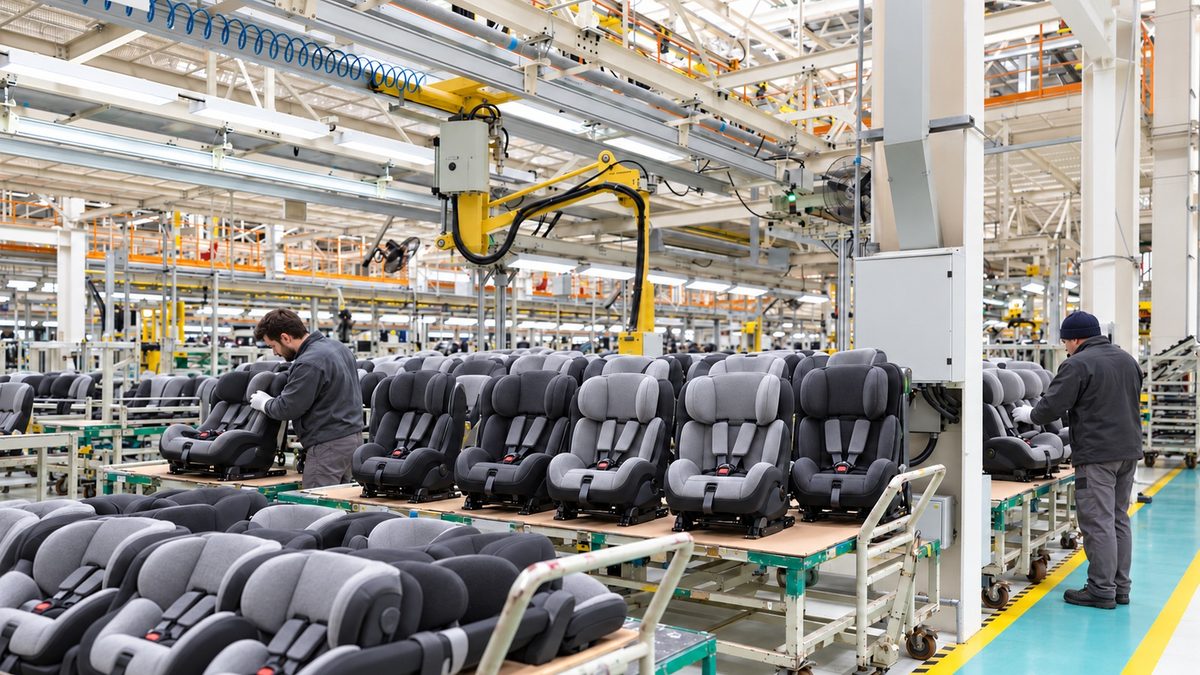
We make R129 child car seats
This guide is maintained by a child car seat factory. If you are building or sourcing an R129 range, we can develop it with you — OEM or ODM — and support Technical Service testing, type approval and conformity of production.
- Infant carriers and rear-facing i-Size seats
- Rotating ISOFIX and convertible seats
- High-back boosters 100–150 cm
- Booster cushions 125–150 cm
- Fabrics, colours, labels and R129 packaging for your brand
 Guide
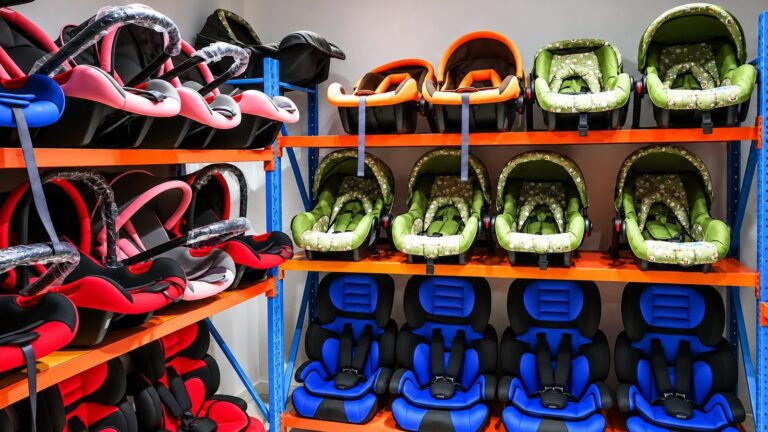
Car Seats 0-12 Years Under R129: One Seat for All?
Car seats 0-12 years: can one R129 seat really cover every stage? We explain stature-based approval, testing trade-offs and what importers must check.
 Guide
R129 conformity of production: batch testing explained
Passing type approval is the start. R129 Annex 12 sets how many production seats are crash-tested and what happens when a batch fails. Here are the numbers.
 Guide
Changing an R129-approved seat: modifications, extensions and re-testing
New fabric, a different buckle, a longer size range: brands change products all the time. Under R129 each change goes through the same path. Here it is.
R129 questions people ask most
Many importers and brands see “car seats 0-12 years” in product requests because it sounds like the perfect one-SKU solution. Under UN Regulation No. 129, however, age is not an approval parameter. R129 approvals are tied to stature, not years. This article explains what a 0-12 years claim really means, whether one seat can cover the full span, and what you must verify before adding such a product to your range.
What “0-12 years” means under R129
UN Regulation No. 129 does not approve car seats by age groups. It approves a product for a defined stature range and, where applicable, specific installation modes. The age label on a box is a marketing translation: a 150 cm child is roughly 12 years old, but that varies from child to child. A seat marketed as “car seats 0-12 years” must therefore have an approval covering the relevant height span, usually from newborn stature up to 150 cm. The approval label will show one or more stature bands, not an age bracket. Multi-stage products may have different approved stature ranges for their harness and booster configurations. Importers should always read the approval label and the type-approval certificate, not the retail packaging.
Can one physical seat really cover every stage?
Technically yes, but only if the product passes type-approval tests for each configuration. A true 0-12 seat must serve as a rear-facing infant carrier or reclined seat for a newborn, convert to forward-facing with harness for a toddler, and later work as a high-back booster using the vehicle belt. Each mode has different load paths, belt routing, and side-impact requirements. The challenge is not regulation, but engineering: a shell long enough for a 150 cm child must also cradle a newborn without excessive recline or poor belt fit. Many buyers report that customers who buy such seats often find the booster mode less comfortable than a dedicated booster, or the infant insert awkward in daily use. That does not make the product non-compliant—it means you need to set realistic expectations and provide clear instructions.

Approval testing for multi-stage seats
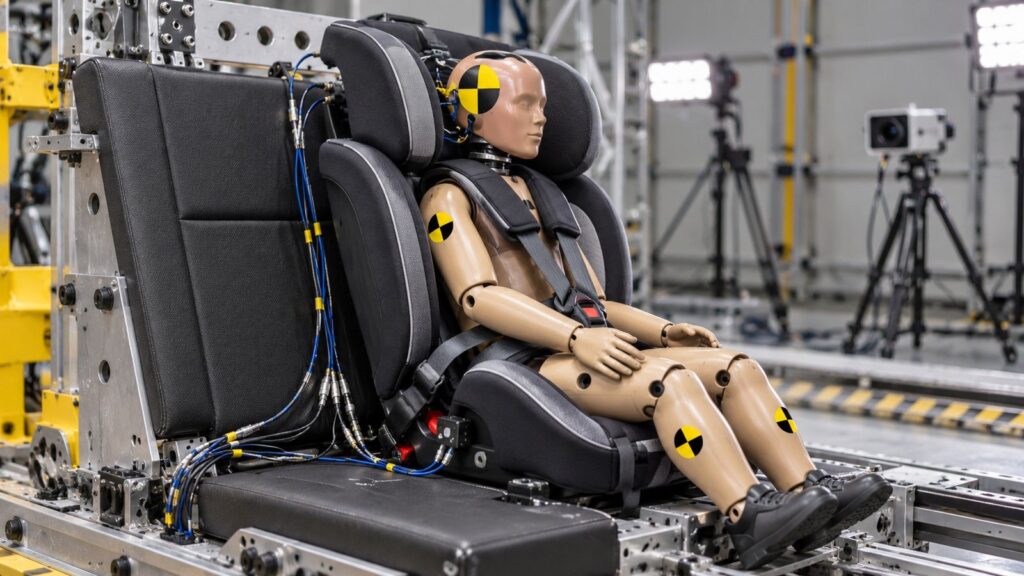
Under R129, every mode must be tested. A seat approved for multiple stages of growth may require dynamic tests with multiple Q-dummies (newborn, toddler, older child) in both rear-facing and forward-facing positions, plus side-impact tests. The test programme is more extensive than a single-stage seat. The test configurations depend on the product and the applicable approval requirements. Brands should budget more time and cost for type approval of a multi-stage seat. Also, if the seat can be installed both with ISOFIX and vehicle belt, each installation method in each stature band needs validation unless the approval explicitly covers only one method.
Marketing “0-12 years” without misleading the market
Under R129, the approval label is the legal reference. It shows the stature range and sometimes the mass limit, but never an age. If you market a seat as “0-12 years”, you must make sure the height range (e.g., 40–150 cm) is clearly stated and that the consumer instructions say when to switch from rear-facing to forward-facing and from harness to booster. A common compliance problem is advertising “birth to 12 years” when the seat actually has a lower height limit of, say, 60 cm, or an upper limit below 150 cm. Such claims can lead to misuse and product liability issues. We recommend checking the type-approval certificate and the approval label on the production unit before finalising packaging copy. See also our article “How to read an R129 approval label”.
Should you add a 0-12 seat to your product line?
The business case depends on your target market. Some distributors want one SKU to reduce inventory. Parents in some countries prefer a single seat that lasts the whole childhood. But the development cost is higher, and the product may be bulkier than a dedicated booster. If you plan to import a white-label 0-12 seat, request the full approval documentation and verify that the manufacturer has tested all claimed configurations. Do not rely on the supplier’s marketing leaflet. Ask for the test report summary and check the stature bands against the R129 04 series requirements. If the supplier cannot show the approval for the booster mode, for example, you cannot legally sell it as a booster. Many buyers report that suppliers sometimes blur the difference between “suitable up to 150 cm” and “approved up to 150 cm”, so push for evidence.
Common compliance pitfalls for 0-12 year claims
- Using age instead of stature in the manual or on the carton. R129 requires the manual to state the applicable stature range; age is optional but must not replace it.
- Mixing R44 and R129 terminology. A product cannot be both R44 and R129 approved for the same configuration; if it is dual-approved, the two regimes are separate.
- Adding aftermarket accessories (head cushions, chest pads) that were not part of the type approval. Any change can invalidate the approval unless re-tested.
- Failing to update the manual when the approval changes to the 04 series.
- Marketing a seat as 0-12 when the booster mode only starts at a height or weight beyond the harness mode’s approved limits, leaving a gap between the forward-facing harness mode and the booster mode.
For more on how changes affect approval, see our article “Changing an R129-approved seat: modifications, extensions and re-testing”.
FAQ
Is there an official R129 category for 0-12 years?
No. R129 approvals are based on stature ranges, not age. A seat marketed as 0-12 years will show one or more stature bands on the approval label, typically from a newborn height to 150 cm. The age is only a rough conversion for consumer guidance.
What is the minimum height for a seat marketed as 0-12 years?
The minimum is usually a height within the newborn range, depending on the product, because that is the typical newborn stature. The approval certificate will state the exact lower limit. Always confirm that the seat can be used with a newborn insert if needed and that the insert is part of the type approval.
Can a 0-12 seat be used rear-facing for the entire period?
R129 requires rear-facing up to at least 15 months, but after that forward-facing is permitted if the seat is approved for it. A 0-12 seat will normally be used rear-facing in the early stature range and then forward-facing with harness or as a booster in the higher range. It is not required to keep the child rear-facing to 12 years.
How can importers verify that a 0-12 seat genuinely covers the full range?
Check the approval label on the production sample and the type-approval certificate. The label will list the stature range(s) and any installation restrictions. If the supplier claims the booster mode works up to 150 cm, ensure the label explicitly includes that range. Cross-check the product manual for mode-switch instructions.
Does R129 prohibit using a 0-12 seat if the child is under 15 months?
No, as long as the child’s stature is within the approved range and the seat is used rear-facing until at least 15 months. The 15-month rule is a minimum for forward-facing; it does not prevent rear-facing use from birth.